Obtaining a UK Visa: Routes, Costs and Requirements
Everything you need to know about obtaining a UK visa. From choosing the right route to understanding the application process and visa fees.
Quick Answer
Getting into the United Kingdom as a foreign national requires navigating one of the world's most complex immigration systems. With over 100 visa categories, strict documentation requirements, and fees ranging from £100 to £5,000+, choosing the right route matters enormously. According to Home Office statistics, the UK processed over 6 million visa applications in 2023—but understanding which visa fits your situation is the crucial first step.
The UK Visa System: A Tube Map Approach
Think of UK immigration like the London Underground. Each "line" represents a different purpose for coming to Britain—work, study, family, business—and each "station" is a specific visa category. Some journeys are short (Zone 3: six months), others medium-term (Zone 2: one to three years), and some lead to permanent settlement (Zone 1: five years or more).
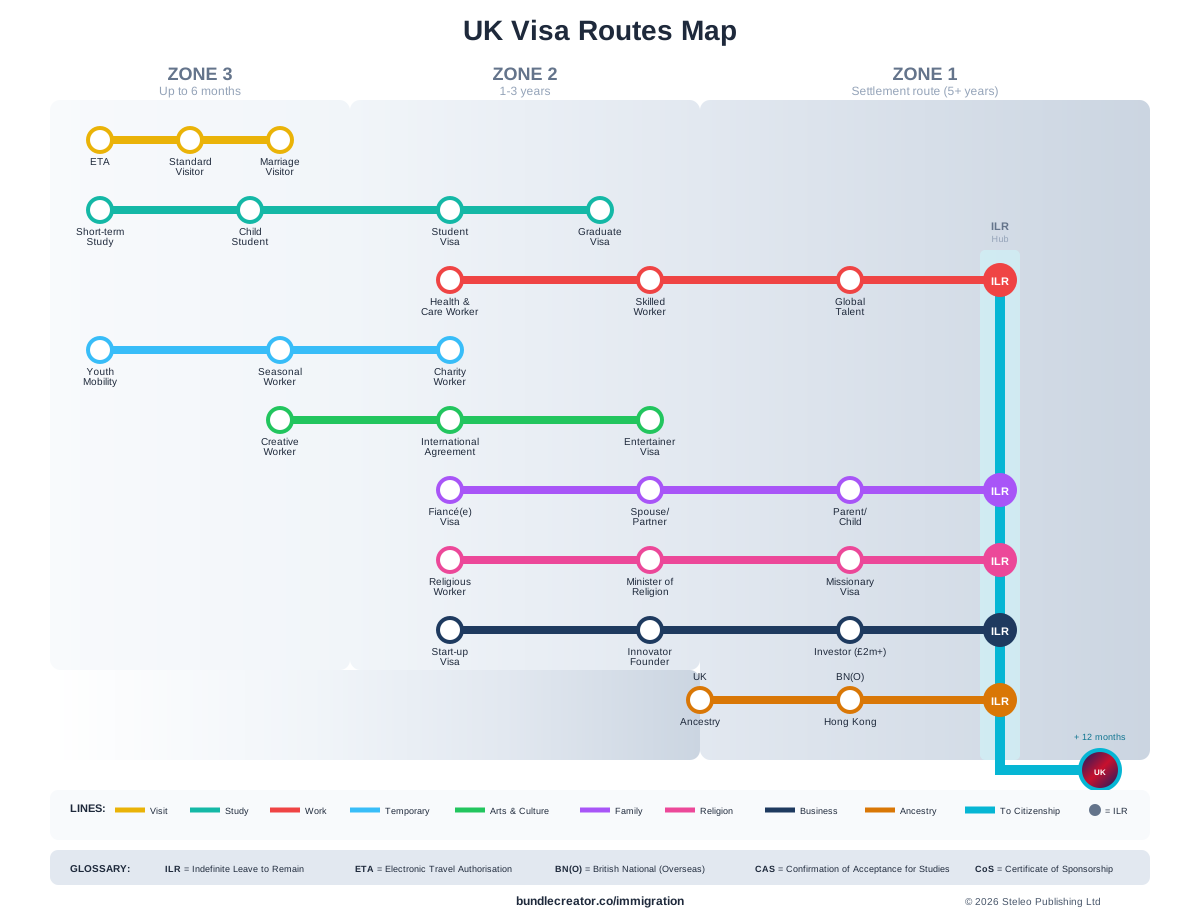
Understanding the Zones
Zone 1: Settlement Routes (5+ years to ILR)
These visas lead to Indefinite Leave to Remain—the right to stay permanently. After holding ILR for 12 months, you can apply for British citizenship.
- Work Line: Skilled Worker, Health & Care Worker, Global Talent
- Family Line: Spouse/Partner, Parent/Child
- Business Line: Innovator Founder, Investor
- Religion Line: Minister of Religion
- Ancestry Line: UK Ancestry, BN(O) Hong Kong
Zone 2: Medium-Term Routes (1-3 years)
Temporary but often renewable. Some lead to settlement, others don't.
- Study Line: Student Visa, Graduate Visa
- Temporary Work Line: Youth Mobility Scheme
- Arts & Culture Line: Creative Worker, International Agreement
- Business Line: Start-up Visa (initial stage)
Zone 3: Short-Term Routes (up to 6 months)
Visits and short stays. No path to settlement. Limited work rights.
- Visit Line: ETA, Standard Visitor, Marriage Visitor
- Study Line: Short-term Study
- Temporary Work Line: Seasonal Worker, Charity Worker
UK Immigration by the Numbers
Home Office and ONS statistics paint a picture of UK immigration flows:
Visa Applications (2023)
| Category | Applications | Grant Rate |
|---|---|---|
| Visit | 3.2 million | 88% |
| Work | 423,000 | 97% |
| Study | 486,000 | 95% |
| Family | 72,000 | 85% |
| Settlement (ILR) | 134,000 | 92% |
| Total | ~6.5 million | ~90% |
Net Migration Context
According to ONS estimates, net migration to the UK reached 685,000 in the year ending June 2023—a historic high. This figure represents the difference between people arriving (1.2 million) and leaving (508,000).
| Migration Category | Estimated Numbers |
|---|---|
| Work-related | 272,000 |
| Study-related | 249,000 |
| Family-related | 71,000 |
| Other | 93,000 |
Understanding these flows helps contextualise the political pressures driving policy changes.
The 8 Main Visa Routes Explained
The UK visa system can be understood as 8 distinct "lines"—like the London Underground. Each line represents a different purpose for coming to Britain, with multiple "stations" (visa categories) along the way.
1. Visit Line (Yellow)
Short-term visits for tourism, business, and family.
Stations on this line:
- ETA (Electronic Travel Authorisation) — £10, for visa-exempt nationals
- Standard Visitor — Up to 6 months for tourism, business meetings, medical treatment
- Marriage Visitor — For marrying in the UK (must leave afterwards)
Key facts:
- 3.2 million visitor visas granted (2023)
- 88% approval rate
- No path to settlement—you must leave
2. Study Line (Teal)
Education routes from language courses to doctorates.
Stations on this line:
- Short-term Study — Up to 11 months for English language courses
- Child Student — Ages 4-17 at independent schools
- Student Visa — Degree-level study at licensed sponsors
- Graduate Visa — 2 years post-study work (3 for PhD)
Key requirements:
- Confirmation of Acceptance for Studies (CAS) from licensed sponsor
- Proof of funds: £1,334/month (London) or £1,023/month (elsewhere)
- English language evidence (usually B2)
Statistics:
- 486,000 Student visas granted (2023)
- International students contribute £37 billion annually to UK economy
- Graduate visa provides 2-3 years to find sponsored work
3. Work Line (Red)
Skilled employment routes leading to settlement.
Stations on this line:
- Health & Care Worker — NHS and social care roles with reduced fees
- Skilled Worker — Main employment route (replaced Tier 2)
- Global Talent — Exceptional talent in science, arts, digital technology
Key requirements (Skilled Worker 2026):
- Job offer from a licensed sponsor
- Minimum salary of £41,700 (or going rate, whichever higher)
- Role at RQF Level 6 (graduate level) or above
- B2 English language proficiency
Statistics:
- 286,000 Skilled Worker visas granted (2023)
- 97% approval rate
- 5 years to ILR (3 for Health & Care in some cases)
4. Temporary Work Line (Light Blue)
Short-term work without a path to settlement.
Stations on this line:
- Youth Mobility Scheme — Ages 18-35 from eligible countries, 2 years
- Seasonal Worker — Agriculture and poultry work, up to 6 months
- Charity Worker — Unpaid work for registered charities
Key facts:
- Youth Mobility: ~40,000 places per year, ballot system for some countries
- Seasonal Worker: Designed for harvest seasons, no switching allowed
- No route to settlement—time-limited stays only
5. Arts & Culture Line (Green)
Creative industries and cultural exchange.
Stations on this line:
- Creative Worker — Film, TV, fashion industry roles
- International Agreement — Employees of overseas governments, international organisations
- Entertainer Visa — Performers at specific events
Key facts:
- Designed for specific projects or events
- Often shorter durations (3-24 months)
- Some roles may transition to Skilled Worker for longer stays
6. Family Line (Purple)
Joining loved ones who are British citizens or settled in the UK.
Stations on this line:
- Fiancé(e) Visa — 6 months to marry, then switch to spouse visa
- Spouse/Partner Visa — For married partners or those in civil partnerships
- Parent/Child Visa — Parents of British children, or children of settled persons
Key requirements (Spouse/Partner):
- Genuine, subsisting relationship
- Sponsor's minimum income of £29,000 (2026 threshold)
- Adequate accommodation
- English language requirement (A1 initially, progressing to B1)
Statistics:
- 72,000 Family visa applications (2023)
- 85% approval rate
- 5-year route to ILR (or 10 years if income threshold not met)
7. Religion Line (Pink)
Religious workers and ministers.
Stations on this line:
- Religious Worker — Non-pastoral roles in religious organisations
- Minister of Religion — Leading congregations, performing religious duties
- Missionary Visa — Spreading religious beliefs (not employed by UK organisation)
Key requirements:
- Sponsorship from a licensed religious organisation
- Genuine religious role, not primarily administrative
- English language proficiency
Path to settlement: Yes, after 5 years for Ministers of Religion
8. Business Line (Navy)
Entrepreneurs and investors building UK businesses.
Stations on this line:
- Start-up Visa — New entrepreneurs with innovative, viable, scalable ideas (2 years)
- Innovator Founder — Experienced entrepreneurs with £50,000+ investment
- Investor (£2m+) — High-net-worth individuals investing in UK businesses
Key requirements:
- Endorsement from approved body (Start-up and Innovator)
- Genuine business plan with growth potential
- Access to required investment funds
Path to settlement:
- Innovator Founder: 3 years (fastest business route)
- Investor: 2-5 years depending on investment level
Ancestry Route (Amber)
A special route for those with British heritage.
Stations on this line:
- UK Ancestry — Commonwealth citizens with UK-born grandparent
- BN(O) Hong Kong — British National (Overseas) status holders
Key requirements (Ancestry):
- Commonwealth citizen
- Grandparent born in UK, Channel Islands, or Isle of Man
- Able and willing to work
Key requirements (BN(O)):
- British National (Overseas) status
- Normally resident in Hong Kong
Path to settlement: Yes, after 5 years for both routes
Settlement: The Final Destination
After qualifying periods on eligible visas, you can apply for Indefinite Leave to Remain (ILR).
Typical paths to ILR:
| Route | Qualifying Period |
|---|---|
| Skilled Worker | 5 years |
| Health & Care Worker | 5 years |
| Family (partner) | 5 years |
| Ancestry | 5 years |
| BN(O) Hong Kong | 5 years |
| Innovator Founder | 3 years |
| Global Talent | 3-5 years |
| Investor | 2-5 years |
| Long residence | 10 years |
After holding ILR for 12 months, you can apply for British citizenship through naturalisation.
The Application Process: Step by Step
Regardless of visa type, most applications follow similar steps:
Step 1: Determine Your Route
Before anything else, identify which visa category fits your circumstances:
- Why am I going? (Work, study, family, visit, business)
- How long do I want to stay? (Days, months, years, permanently)
- Do I have a sponsor? (Employer, university, family member)
- What can I afford? (Fees, health surcharge, maintenance)
Applying for the wrong category wastes money and creates refusal history that affects future applications.
Step 2: Gather Your Documents
Documentation requirements vary by route, but typically include:
| Document Type | Examples |
|---|---|
| Identity | Valid passport, birth certificate |
| Relationship | Marriage certificate, cohabitation evidence |
| Financial | Bank statements, payslips, tax returns |
| Employment | Certificate of Sponsorship, contracts |
| Educational | CAS, qualifications, English test results |
| Medical | TB test results (if required) |
Step 3: Complete the Online Application
All UK visa applications are submitted online through GOV.UK.
- Create an account on the UK Visas and Immigration portal
- Select your visa category
- Complete the application form (can save and return)
- Upload supporting documents as PDFs
- Pay the application fee and Immigration Health Surcharge
- Book your biometric appointment
Step 4: Biometrics and Submission
Attend an appointment at a Visa Application Centre (VAC) to:
- Provide fingerprints
- Have your photograph taken
- Submit original documents (if required)
- Potentially attend an interview
Step 5: Wait for a Decision
Processing times vary significantly:
| Visa Type | Standard Processing |
|---|---|
| Visitor | 3 weeks |
| Skilled Worker | 3-8 weeks |
| Student | 3-6 weeks |
| Family | 8-24 weeks |
| Settlement | 6 months+ |
Priority services offer faster processing for additional fees.
Costs: What You'll Actually Pay
UK immigration isn't cheap. Here's what to budget:
Application Fees (2026)
| Visa Type | Fee Range |
|---|---|
| Visitor (6 months) | £115 |
| Student | £490 |
| Skilled Worker | £719 - £1,420 |
| Family (partner) | £1,538 |
| Settlement (ILR) | £2,885 |
Immigration Health Surcharge
Most visas exceeding 6 months require IHS payment upfront:
| Applicant Type | Annual Rate |
|---|---|
| Adults | £1,035 |
| Students/Under 18 | £776 |
A 5-year Skilled Worker visa means £5,175 in IHS alone.
Total Cost Examples
| Scenario | Approximate Cost |
|---|---|
| Student (3-year course) | £2,818 (visa) + £2,328 (IHS) = £5,146 |
| Skilled Worker (5 years) | £1,420 + £5,175 + £2,885 (ILR) = £9,480 |
| Spouse (5-year route) | £1,538 + £5,175 + £2,885 (ILR) = £9,598 |
These figures exclude legal fees, travel, document preparation, and English tests.
Common Reasons Applications Fail
Home Office refusal statistics reveal patterns worth understanding:
Top Refusal Reasons
| Reason | Frequency |
|---|---|
| Insufficient financial evidence | 35% |
| Genuine intention doubts | 25% |
| Missing or incomplete documents | 18% |
| English language issues | 10% |
| Sponsor problems | 7% |
| Other | 5% |
How to Avoid Refusal
Financial evidence:
- Funds held for required period (usually 28 days)
- Clear, legible bank statements
- Correct calculations for your specific route
Genuine intention:
- Strong ties to home country
- Clear, consistent purpose for visit/stay
- Logical travel and career history
Documentation:
- Everything requested in checklist
- Certified translations for non-English documents
- Clear copies, properly organised
Preparing Your Application Bundle
A well-organised application improves your chances and speeds processing.
What Caseworkers Want
Immigration caseworkers review hundreds of applications. They appreciate:
- Clear organisation — Documents in logical order
- Proper indexing — Page numbers and contents list
- Legible copies — High-quality scans
- Completeness — Everything requested, nothing missing
Professional Document Organisation: BundleCreator makes it easy to create UK legal bundles if you need to go to court. A bundle sets out your case to The Judge. Start your trial today.
After Approval: What Happens Next
Collecting Your Visa
Successful applicants receive either:
- Vignette — a sticker in your passport, which remains valid until it expires
- eVisa — a digital record of your identity and immigration status, which you view through your UK Visas and Immigration (UKVI) account. eVisas have replaced physical immigration documents such as biometric residence permits (BRPs).
First Steps in the UK
- Check your eVisa — sign in to your UKVI account and make sure your name, passport details and visa conditions are correct. BRPs are no longer issued, so there is nothing to collect.
- HMRC registration — National Insurance number for work
- Starting work — before you start, your employer must check your right to work. If you have an eVisa, you prove it with a share code from your UKVI account. The code starts with "W" and lasts 90 days, and your employer uses it with your date of birth.
- Healthcare registration — Register with a GP
- Banking — Open UK bank account
When Things Go Wrong
Not every application succeeds. If refused, you have options:
Administrative Review — For caseworker errors (£80, 14-28 days to apply)
Tribunal Appeal — For human rights cases (success rate ~45%)
Fresh Application — Address refusal reasons and reapply
Judicial Review — Challenge lawfulness of decision (complex, expensive)
For detailed guidance on challenging refusals, see our guide: Visa Refused: What Happens Next.
Frequently Asked Questions
Which visa is easiest to get?
The ETA and Standard Visitor visa have highest approval rates (~88-99%). Work visas have high approval but strict eligibility. Family visas have lower approval rates due to documentation complexity.
How long does the whole process take?
From gathering documents to receiving a decision: 2-6 months typically. Priority processing can reduce this to weeks for some routes.
Can I switch between visa types?
Often yes, but not from all categories. Visitors generally cannot switch. Students can switch to work routes. Rules vary—check specific guidance.
Do I need a solicitor or immigration adviser?
Not required, but professional help improves outcomes for complex cases. At minimum, research thoroughly before applying.
What if my circumstances change?
You can often apply to extend or switch visas before your current one expires. Overstaying has serious consequences—plan ahead.
The Bottom Line
The UK visa system is complex, but navigable. Success requires:
- Choosing the right route — Match your situation to available categories
- Meeting all requirements — No shortcuts, no assumptions
- Documenting thoroughly — Evidence wins applications
- Applying accurately — Errors cause delays and refusals
- Acting within deadlines — Immigration is time-sensitive
Whether you're coming to work, study, join family, or build a business, understanding the system is your first step. The UK welcomed over 6 million visitors and migrants through its visa system last year. With proper preparation, you can be among those who navigate it successfully.
This guide provides general information about UK visa applications. It is not legal advice. Immigration rules change frequently—always verify current requirements on GOV.UK before applying. For complex situations, consult a registered immigration adviser.
Sources:
Ready to create your Immigration Tribunal Bundle?
Templates for First-tier and Upper Tribunal immigration and asylum appeals, including human rights.
See how our court bundle software builds the index, page numbers and bookmarks for you.
Free tools mentioned in this article
Watch the short walkthrough
Short tutorial videos showing the exact BundleCreator features mentioned in this article.

Onboarding
Getting Started with BundleCreator
Your first thirty seconds in BundleCreator — the dashboard, the trial banner, the Create Bundle button top right, the area-of-law modal covering 25 areas of law plus a Pro-tips practice tile, and the editor with sections, document, toolbar, and the Sections / Continuous numbering toggle. Built for litigants in person and legal professionals across England and Wales.

Onboarding
Creating Your First Bundle
Create a bundle in three clicks — from the dashboard Create Bundle button, through the 23-area-of-law picker, to picking a hearing type and watching the editor open. This walkthrough uses the Pro-tips Starter Bundle as the example so you see the flow without real-case complexity.

Onboarding
Using Templates Effectively
Over 370 templates across 25 areas of law, pre-loaded by area + hearing type. See the pen icon in the Actions column, type over the yellow guidance, and watch the yellow strip out automatically at export — drafting prompts stay in your editor and never reach the judge. Built for litigants in person and legal professionals across England and Wales.
About the Author
Stevie Hayes
Legal Technology Compliance Specialist & Founder
Former Head of Data Security at Holland & Barrett, a Governance, Risk and Compliance specialist, Stevie brings over 30 years of technology expertise—including delivery for Sky, Disney, and BT—to court bundle compliance. His five years navigating the UK Family Court, both with legal representation and as a litigant in person, revealed the gap between what courts require and what tools deliver.
Areas of Expertise:
ISO 27001 Information Security • Data Security & Compliance • Practice Direction 27A • UK Family Court Procedures