Visa Refused: What Happens Next
What to do when your UK visa application is refused. Understanding your options including Administrative Review, appeals, and fresh applications.
Quick Answer
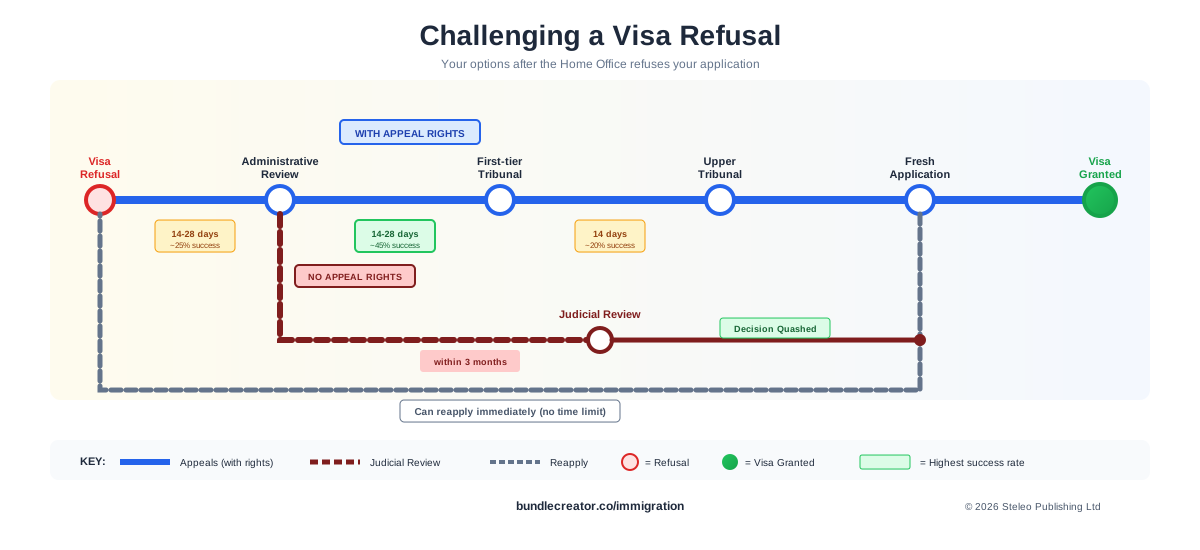
A refused UK visa is not necessarily the end of the road. Ministry of Justice statistics show over 40% of immigration appeals heard by the First-tier Tribunal succeed. Depending on visa type and reasons for refusal, available routes include Administrative Review, appeal to the First-tier Tribunal (Immigration and Asylum Chamber) under the Tribunal Procedure Rules 2014, or judicial review. A fresh application addressing the refusal reasons often succeeds where the first attempt failed.
Understanding Your Refusal
When the Home Office refuses your application, they must explain why. This explanation is your roadmap for what comes next.
What the Refusal Letter Tells You
| Section | Information Provided |
|---|---|
| Decision | The formal refusal and relevant Immigration Rules cited |
| Reasons | Specific paragraphs explaining each ground for refusal |
| Evidence assessment | How the decision-maker evaluated your documents |
| Appeal/review rights | Whether you can challenge the decision and how |
| Deadlines | Time limits for any challenge (strictly enforced) |
Read your refusal letter multiple times. Every word matters. The specific Immigration Rules cited determine your options going forward.
The Three Main Paths Forward
Option 1: Administrative Review
Administrative Review is an internal Home Office reconsideration. It's designed to catch caseworker errors, not to consider new evidence or arguments.
When it's available:
- Most points-based system applications (Skilled Worker, Student, etc.)
- Some visit visa applications
- Applications made from within the UK and overseas
What it can fix:
- Caseworker errors in assessing evidence you submitted
- Misapplication of the Immigration Rules
- Failure to consider documents that were included
What it cannot do:
- Consider new evidence
- Overturn discretionary decisions correctly applied
- Challenge policy itself
| Administrative Review Details | Information |
|---|---|
| Time limit (in UK) | 14 calendar days |
| Time limit (overseas) | 28 calendar days |
| Fee | £80 |
| Processing time | 28 working days (target) |
| Success rate | Approximately 20-25% |
Administrative Review success rates are relatively low because they're designed narrowly. If your refusal was based on genuinely missing requirements—not caseworker mistakes—Administrative Review is unlikely to help.
Option 2: Appeal to the First-tier Tribunal
An appeal is fundamentally different from Administrative Review. You're asking an independent immigration judge to reconsider your case from scratch. You can submit new evidence. You can argue your case (or have a representative do so).
When you have appeal rights:
- Human rights claims (Article 8 – family and private life)
- Protection and asylum claims
- EU Settlement Scheme refusals
- Some EEA family permit decisions
- Certain deportation and revocation decisions
When you typically DON'T have appeal rights:
- Visitor visa refusals
- Most points-based system refusals (without human rights element)
- Entry clearance for work or study
- In-country extension refusals (most categories)
Tribunal Statistics: The Real Numbers
Ministry of Justice tribunal statistics tell an important story:
| Immigration & Asylum Tribunal Performance (2023) | Data |
|---|---|
| Total appeals received | 84,127 |
| Appeals determined | 73,891 |
| Allowed (appellant wins) | 31,894 (43%) |
| Dismissed (Home Office wins) | 37,241 (50%) |
| Withdrawn | 4,756 (6%) |
Breaking this down by appeal type reveals significant variation:
| Appeal Type | Success Rate |
|---|---|
| Human Rights (Article 8) | 45-50% |
| Asylum | 35-45% (varies by nationality) |
| EEA | 50-60% |
| Deportation | 25-35% |
These figures include both represented and unrepresented appellants. Success rates are measurably higher for those with professional representation.
| Tribunal Appeal Details | Information |
|---|---|
| Time limit (in UK) | 14 calendar days |
| Time limit (abroad) | 28 calendar days |
| Fee (paper decision) | £80 |
| Fee (oral hearing) | £140 |
| Processing time | 4-12 months |
Option 3: Fresh Application
Sometimes the best response to a refusal is to apply again—properly this time.
When this makes sense:
- The refusal identified fixable problems (missing documents, insufficient funds)
- Your circumstances have genuinely changed
- You can now provide evidence you couldn't before
- You were applying for the wrong visa category
When it doesn't make sense:
- Nothing has changed since the refusal
- You're hoping for a different caseworker
- Fundamental eligibility issues you cannot address
Important warning: Each refusal stays on your immigration record. Multiple refused applications can harm future chances and may raise concerns about genuine intentions.
Fresh Applications: Getting It Right Second Time
If you decide to apply again rather than appeal, approach the new application strategically.
- Identify every refusal reason — Go through the decision methodically and list each problem identified
- Gather evidence to counter each point — If funds were insufficient, show higher balances. If the relationship wasn't believed, provide more comprehensive evidence
- Consider what has changed — Can you now meet requirements you couldn't before? Has your sponsor's income increased? Have you obtained English test results?
- Don't repeat mistakes — If documents were unclear, provide better copies. If information was contradictory, explain and reconcile
When to wait before reapplying:
- Income thresholds not met — Wait until you (or your sponsor) genuinely meet requirements
- Relationship credibility doubts — Accumulate more relationship evidence over time
- Immigration history concerns — Multiple recent refusals may require waiting before applying again
The Appeal Process: Step by Step
If you have appeal rights, here's what to expect:
Step 1: Lodge Your Appeal (Strict Deadlines)
Appeals are submitted online through HM Courts & Tribunals Service.
| Where You Are | Deadline | Where to Apply |
|---|---|---|
| In the UK | 14 calendar days | HMCTS Online |
| Outside UK | 28 calendar days | HMCTS Online |
These deadlines are strictly enforced. Extensions are granted only in exceptional circumstances—illness, postal failures, circumstances genuinely beyond your control. "I didn't understand" or "I was gathering evidence" typically won't suffice.
Step 2: Prepare Your Appeal Bundle
Your appeal bundle is your case in documentary form. Immigration judges read bundles before hearings and rely heavily on written evidence.
A professional appeal bundle should contain:
| Section | Contents |
|---|---|
| Index | Page-numbered list of all documents |
| Grounds of appeal | Legal arguments why refusal was wrong |
| Witness statements | Your account and supporting witnesses |
| Refusal decision | The decision you're appealing |
| Original application | Your initial submission |
| Evidence | Documents supporting your case |
| Legal authorities | Relevant case law and Immigration Rules |
| Country information | For asylum cases, objective reports |
Bundle organisation matters. Tribunal judges repeatedly emphasise that well-organised, clearly paginated bundles help appellants. Disorganised evidence frustrates judges and may obscure strong points.
Bundle Organisation Principles
- Paginate consecutively — Every page numbered from 1 through the entire bundle
- Create a detailed index — List every document with its page reference so the judge can locate evidence quickly
- Use logical sections — Group related documents together (identity, relationship, financial, etc.)
- Include only relevant material — Padding bundles with irrelevant documents frustrates judges and obscures important evidence
- Ensure legibility — Poor photocopies, tiny text, or illegible handwriting undermine otherwise strong evidence
Evidence That Wins Appeals
Different appeal types require different evidence, but certain principles apply broadly.
For Human Rights (Article 8) appeals:
- Evidence of genuine, subsisting relationship
- Length and nature of family/private life in the UK
- Best interests of any children involved
- Proportionality arguments (why removal would be disproportionate)
- Integration evidence (employment, community ties, language)
For asylum appeals:
- Detailed witness statement explaining the claim
- Country of origin information (objective reports)
- Expert evidence where relevant
- Medical evidence of past persecution
- Documentation corroborating your account
Professional Bundle Preparation: BundleCreator makes it easy to create UK legal bundles if you need to go to court. A bundle sets out your case to The Judge. Start your trial today.
Step 3: Home Office Response
After you lodge your appeal, the Home Office reviews the case and provides a response bundle containing:
- Their reasons for defending the refusal
- Any additional evidence they're relying on
- Legal arguments supporting their position
This typically arrives 4-8 weeks before your hearing date.
Step 4: The Hearing
Most appeals proceed to an oral hearing before an Immigration Judge. Hearings typically last 2-4 hours.
Hearing structure:
- Judge's introduction — Confirming parties, issues, and procedure
- Appellant's evidence — You (and witnesses) give evidence and face cross-examination
- Home Office case — The Presenting Officer argues for refusal to stand
- Closing submissions — Both sides summarise arguments
- Reserved decision — Usually written decision sent later (2-6 weeks)
Practical tips:
- Dress respectfully
- Arrive early
- Bring copies of all documents
- Answer questions directly
- Address the judge, not the Home Office representative
- If you don't understand a question, ask for clarification
Step 5: The Decision
Decisions arrive in writing. The judge either:
- Allows the appeal — The refusal is overturned
- Dismisses the appeal — The refusal stands
If allowed, the Home Office must reconsider your application in light of the judge's findings. This usually (but not always) leads to your visa being granted.
If Your Appeal Fails: Further Options
A dismissed First-tier Tribunal appeal isn't always the final word.
Upper Tribunal Appeal
You can appeal to the Upper Tribunal, but only on a point of law. This means arguing that the First-tier judge:
- Made a legal error in reasoning
- Failed to apply the correct legal test
- Made a decision no reasonable judge could reach
- Failed to give adequate reasons
You cannot simply argue the judge weighed evidence incorrectly or that you disagree with findings of fact.
| Upper Tribunal Details | Information |
|---|---|
| Permission required | Yes (must apply first) |
| Time limit | 14 days (in UK) |
| Fee | No fee (the £80 paper / £140 oral fees apply only at the First-tier Tribunal) |
| Success rate | ~15-20% |
Most Upper Tribunal applications fail because they're really arguments about facts, dressed up as legal points.
Judicial Review
For decisions with no appeal right, judicial review may be possible. This is a High Court or Upper Tribunal challenge to the lawfulness (not merits) of a decision.
Judicial review can challenge:
- Unlawful decisions (outside decision-maker's powers)
- Irrational decisions (so unreasonable no rational person would make them)
- Procedurally unfair decisions (failure to follow proper process)
Limitations:
- Time limit: 3 months, but act promptly
- Cost: Significant (court fees plus legal costs if unsuccessful)
- Legal aid: Rarely available
- Standard: Very high—most fail
Judicial review is a last resort, not a standard route.
Refusal Patterns: What the Data Shows
Home Office data reveals patterns in visa refusals that inform strategic applications:
Refusal Rates by Visa Category (2023)
| Visa Category | Applications | Refusal Rate |
|---|---|---|
| Visitor | 3.2 million | 12% |
| Skilled Worker | 286,000 | 3% |
| Student | 486,000 | 5% |
| Family | 72,000 | 15% |
| Settlement (ILR) | 134,000 | 8% |
Most Common Refusal Reasons
Analysis of published refusal statistics shows recurring themes:
| Reason | Frequency | Prevention |
|---|---|---|
| Insufficient financial evidence | 35% | Clear bank statements, correct calculations |
| Genuine intention doubts | 25% | Strong ties to home, clear purpose |
| Missing documents | 18% | Checklist approach, certified translations |
| English language | 10% | Approved test, correct level |
| Other | 12% | Various |
Working with Representatives
Immigration appeals are complex. While self-representation is possible, professional help often improves outcomes.
Representation Statistics
Ministry of Justice data shows outcome differences:
| Representation Type | Appeal Success Rate |
|---|---|
| OISC-regulated adviser | 48% |
| Solicitor | 46% |
| Barrister | 52% |
| Self-represented | 32% |
The difference isn't just legal knowledge—it's experience with tribunal procedures, bundle preparation, and advocacy.
Finding Legitimate Help
Only use:
- Solicitors regulated by the SRA
- Barristers regulated by the BSB
- Advisers registered with OISC at appropriate level
Warning signs:
- Not registered/regulated
- Guaranteeing outcomes
- Unusually low fees
- Pressure to pay upfront
- Reluctance to provide credentials
Check registrations at OISC or SRA.
Frequently Asked Questions
Can I appeal a visitor visa refusal?
Generally no. Visitor visa refusals don't carry appeal rights. Your options are Administrative Review (if available) or a fresh application addressing the refusal reasons.
How long do I have to appeal?
14 calendar days if in the UK, 28 calendar days if abroad. These are strict deadlines.
Can I stay in the UK while my appeal is pending?
If you had valid leave when you applied and appealed in time, you typically have "Section 3C leave"—the right to remain until your appeal is decided.
What are my chances of winning?
It depends on your case type. Human rights appeals succeed around 45-50% of the time. But statistics only tell you so much—your specific circumstances matter most.
Do I need a solicitor or immigration adviser?
Not legally required, but representation significantly improves outcomes, particularly for complex cases. At minimum, consider a consultation before deciding your approach.
What if I miss the deadline?
Late appeals require exceptional circumstances. Most late applications fail. If you've missed the deadline, seek urgent legal advice.
Can I work while appealing?
If you applied before your previous permission expired, section 3C of the Immigration Act 1971 extends that permission, including any right to work and its conditions, while the application and any appeal or administrative review you are entitled to are pending. Your employer can confirm this with an online check (if you have an eVisa) or through the Home Office Employer Checking Service, and must recheck every six months. This does not apply if you applied after your permission had expired, or if your appeal can only be brought from outside the UK.
Key Deadlines Summary
| Action | Time Limit |
|---|---|
| Administrative Review (in UK) | 14 days |
| Administrative Review (abroad) | 28 days |
| First-tier Tribunal (in UK) | 14 days |
| First-tier Tribunal (abroad) | 28 days |
| Upper Tribunal permission | 14 days |
| Judicial Review | 3 months (act promptly) |
The Bottom Line
A visa refusal is disappointing, but it's not necessarily final. Understanding your options—Administrative Review, tribunal appeal, or fresh application—and acting within strict deadlines can transform a rejection into eventual success.
The statistics show that appeals do succeed, particularly when well-prepared and professionally presented. Whether you challenge the decision or apply again with stronger evidence, the refusal letter is your starting point for understanding what went wrong and what comes next.
Don't panic. Don't immediately reapply. Read, understand, and then decide your best path forward.
This guide provides general information about challenging UK visa refusals. It is not legal advice. Appeal rights and procedures change—always verify current rules on GOV.UK and consider professional advice for complex cases.
Sources:
Ready to create your Immigration Tribunal Bundle?
Templates for First-tier and Upper Tribunal immigration and asylum appeals, including human rights.
See how our court bundle software builds the index, page numbers and bookmarks for you.
Free tools mentioned in this article
Watch the short walkthrough
Short tutorial videos showing the exact BundleCreator features mentioned in this article.

Onboarding
Getting Started with BundleCreator
Your first thirty seconds in BundleCreator — the dashboard, the trial banner, the Create Bundle button top right, the area-of-law modal covering 25 areas of law plus a Pro-tips practice tile, and the editor with sections, document, toolbar, and the Sections / Continuous numbering toggle. Built for litigants in person and legal professionals across England and Wales.

Onboarding
Creating Your First Bundle
Create a bundle in three clicks — from the dashboard Create Bundle button, through the 23-area-of-law picker, to picking a hearing type and watching the editor open. This walkthrough uses the Pro-tips Starter Bundle as the example so you see the flow without real-case complexity.

Onboarding
Using Templates Effectively
Over 370 templates across 25 areas of law, pre-loaded by area + hearing type. See the pen icon in the Actions column, type over the yellow guidance, and watch the yellow strip out automatically at export — drafting prompts stay in your editor and never reach the judge. Built for litigants in person and legal professionals across England and Wales.
About the Author
Stevie Hayes
Legal Technology Compliance Specialist & Founder
Former Head of Data Security at Holland & Barrett, a Governance, Risk and Compliance specialist, Stevie brings over 30 years of technology expertise—including delivery for Sky, Disney, and BT—to court bundle compliance. His five years navigating the UK Family Court, both with legal representation and as a litigant in person, revealed the gap between what courts require and what tools deliver.
Areas of Expertise:
ISO 27001 Information Security • Data Security & Compliance • Practice Direction 27A • UK Family Court Procedures