"Refused by the Home Office? You may have just 14 days to appeal."
Immigration Tribunal Bundle Software — Ready for the First-tier Tribunal
Templates for asylum, human rights, Article 8, and deportation appeals. Upload your documents — BundleCreator formats and paginates them for the First-tier Tribunal. From £29.99.
Every stop on the journey explains the step, with a template, official form or hearing bundle wherever one is needed
Your uploaded documents are encrypted and stored in our London (UK) region
Built for solicitors, caseworkers, and appellants
7-day trial — no card needed to start your trial
Your Immigration Appeal Journey
Select your case stage
Each stop is a step in the journey. Large rings are hearings where you build a court bundle; small grey dots are steps you file or take, hollow dots are deadlines or events, and diamonds are forms. The key below the map explains every symbol. Click any stop to see what it involves.
Lines:FTT Appeal TypeOnward Appeal RouteJudicial ReviewBail ApplicationsSecretary of State (Home Office)
Stops:Bundle hearing — a court bundle is built hereDecision hearing — the court or tribunal decides the case here; bundle requiredOptional hearing — dashed ring: only held in some casesProcess step — something you file or do, no bundleOptional step — dashed: not always applicable (e.g. only if needed or agreed)
Reading:Blog Insight — purple book icons link to a related article (opens in a new tab)
Timing:⚠ 14 daysstatutory — miss this and lose4 weeksrequired noticetyp. 8motypical wait
Laws:This journey summarises the procedure under Nationality, Immigration and Asylum Act 2002 (s.82 statutory appeal rights, as amended by Immigration Act 2014; ss.86A–86B 24-week determination periods), British Nationality Act 1981 (esp. s.40 deprivation, as amended by Nationality and Borders Act 2022; s.40A appeals), Nationality and Borders Act 2022 Part 2 (ss.31–37: refugee definition, s.32 standard of proof, s.35 internal relocation), Border Security, Asylum and Immigration Act 2025 (ss.40–41 repeals; ss.49–51), Immigration Act 2016 (Schedule 10 immigration bail), Immigration (Citizens' Rights Appeals) (EU Exit) Regulations 2020 (EUSS appeals), Special Immigration Appeals Commission Act 1997 (SIAC — decisions certified under s.40A(2) BNA 1981), Refugee Convention 1951 (Geneva) and 1967 Protocol, European Convention on Human Rights, Articles 3 and 8, Tribunal Procedure (First-tier Tribunal) (Immigration and Asylum Chamber) Rules 2014 (r.19–20 notice of appeal; r.23–24 Home Office bundle; r.24A ASA and respondent review; r.33 permission to appeal), Practice Direction of the IAC of the First-tier Tribunal (1 November 2024), Tribunal Procedure (Upper Tribunal) Rules 2008 (esp. r.21 permission to appeal; r.28–31 immigration JR; r.44 onward appeal to CoA), Practice Directions (18 Dec 2018) and Practice Statements (25 Sep 2012) — Upper Tribunal, Civil Procedure Rules Part 54 / Senior Courts Act 1981 s.31 (judicial review); CPR Part 52 and PD 52D (appeals to the Court of Appeal), Lord Chief Justice's Direction on transfer of immigration JR (2013), Judicial Review and Courts Act 2022 s.2 (Cart JR curtailment — R (Oceana) v Upper Tribunal [2023] EWHC 791 (Admin)), Tribunal Procedure (FtT) (Social Entitlement Chamber) Rules 2008 r.22(2)(a) (asylum support appeals — 3 days; s.103 Immigration and Asylum Act 1999), Tribunals, Courts and Enforcement Act 2007 ss.11, 13 (rights of appeal on a point of law) and Surendran Guidelines (HO unrepresented hearings); Joint Presidential Guidance Note No.2 of 2010 (vulnerable witnesses). General information only — not legal advice.
Immigration appeals follow different routes depending on the type of decision being challenged. Since the Immigration Act 2014, statutory appeal rights to the First-tier Tribunal (Immigration and Asylum Chamber) exist only where the decision involves a human rights claim, a protection claim, or a revocation of protection status / deprivation of British citizenship (s.82 NIAA 2002 as amended by Immigration Act 2014; s.40A BNA 1981). BSAIA 2025 ss.49–50 (in force 12 Aug 2026) add 24-week determination periods (NIAA ss.86A–86B); s.51 (in force 2 Feb 2026) amends particularly serious crime (s.72). The Immigration (Citizens' Rights Appeals) (EU Exit) Regulations 2020 extend appeal rights to EUSS refusals. Pure visa refusals without a human rights ground must be challenged by judicial review, not appeal.
⚠ Filing deadlines and FORUMS vary — pick the right track:
• FTT (IAC) statutory appeal — the Tribunal must receive the appeal no later than 14 days after the decision was sent if you are IN the UK, or 28 days after you receive it if you are OUT of the UK (Tribunal Procedure (FtT) (IAC) Rules 2014, r.19(2)–(3)). Detained appellants have the same 14-day limit (r.19(2)). The accelerated detained appeal scheme in NABA 2022 s.27 is not yet operational.
• Permission to appeal to the Upper Tribunal — within 14 days (in the UK) / 28 days (outside the UK) of written reasons being sent (r.33(2)–(3) FtT(IAC) Rules 2014).
• Court of Appeal (Civil Division) — apply to the UT first: 12 working days in the UK (10 if the decision was emailed or handed to you), 7 working days if detained (5), 38 days outside the UK (10) (UT Rules 2008 r.44(3A)–(3C)). If the UT refuses, file the appellant's notice at the Court of Appeal within 28 days of the UT's permission decision being sent (PD 52D para 3.3).
• Judicial review (Upper Tribunal IAC under UT Rules r.28; or Administrative Court under CPR 54) — promptly and within 3 months. If removal directions are set, issue immediately with an urgent application (UTIAC4 / N463) (PAP para 6).
• SIAC — Special Immigration Appeals Commission for decisions certified under s.40A(2) BNA 1981 (SIAC Act 1997 — separate procedure, not on this map).
• Asylum Support Tribunal — appeals against ASF1 / s.4 / s.95 refusals: notice of appeal within 3 days after receiving the decision — FtT (Social Entitlement Chamber) Rules 2008 r.22(2)(a); s.103 IAA 1999 (separate procedure, not on this map).
• Cart JR of a UT refusal of permission — JRCA 2022 s.2 (TCEA 2007 s.11A): only for no valid application, improper constitution, bad faith or fundamental breach of natural justice; claim within 16 days (CPR 54.7A(2)) (R (Oceana) v UT [2023] EWHC 791 (Admin)).
After lodgement and before the substantive FTT hearing, the Home Office must provide its bundle within 28 days of the date the Tribunal sent it the appeal (r.24(3)). If you have a legal representative, they must provide an Appeal Skeleton Argument and evidence within 28 days after the Home Office bundle, or 42 days after the appeal was lodged, whichever is later (r.24A(1)–(2)); the Home Office then has 14 days to provide its Respondent Review (r.24A(3)). The ASA has a 12-page limit and three sections: factual summary, schedule of disputed issues, and submissions (PD FtT IAC 1 Nov 2024 paras 7.6–7.7). If you are appealing in person, the Tribunal will direct you to explain your case and send your evidence (PD para 7.10), usually through the online service or on Form IAFT-2. If directions are not followed, the Tribunal may take any action it considers just, including excluding evidence (r.6(2); PD paras 5.2–5.3). A Case Management Review (interim hearing) may be listed to narrow the issues and give directions (PD para 6.1).
Select your appeal type to see the appropriate bundle template. If you have no statutory right of appeal, use the Judicial Review track. For Asylum Support / SIAC matters seek specialist advice — these forums have separate rules and shorter deadlines than the IAC.
Important: This journey map shows the typical stages of the relevant court or tribunal proceedings. It is general information, not legal advice. Every case is different. For advice about your specific situation, consult a solicitor or instruct a barrister directly.
The law, court fees and time limits can change. We work hard to keep this map accurate, but it may contain errors or become out of date, so please check anything important against the official source — for example legislation.gov.uk or GOV.UK. To the fullest extent permitted by law, Steleo Publishing Limited does not accept liability for any loss arising from reliance on this map. Each stop represents a stage where a separate bundle may be required; BundleCreator handles the formatting — it does not replace professional legal advice.
Share this journey map
Share the whole journey — title, map, key and laws — as a single image.
An immigration tribunal bundle is the set of documents filed at the First-tier Tribunal (Immigration and Asylum Chamber) for an appeal hearing — Home Office refusal letter, appeal form, witness statement, country evidence, and supporting exhibits, paginated and indexed. BundleCreator is online court bundle software that formats and paginates your immigration appeal bundle automatically. Appeal deadline: 14 days after the decision is sent to you (28 days after you receive it if you are outside the UK).
Last reviewed: 27 September 2026 by Stevie Hayes
Immigration and Asylum Tribunal Bundle UK: In Brief
An immigration tribunal bundle is the appellant's evidence pack filed at the First-tier Tribunal (Immigration and Asylum Chamber) for an appeal against a Home Office decision — refusals of protection (asylum) or human rights claims (including family and private life, and deportation), revocation of protection status, deprivation of citizenship and EU Settlement Scheme decisions. Proceedings run under the Tribunal Procedure (First-tier Tribunal) (Immigration and Asylum Chamber) Rules 2014 and the FTT IAC Practice Direction (in force 1 November 2024). Upper Tribunal appeals proceed under separate rules.
Key rules
Tribunal Procedure (First-tier Tribunal) (IAC) Rules 2014; FTT IAC Practice Direction 2024; Upper Tribunal Rules 2008
Time limits
14 days after the decision is sent if you are in the UK, including if detained; 28 days after receipt if outside the UK (rule 19); late appeals need an application to extend time (rule 20)
Key documents
Appeal notice, Home Office refusal letter, witness statement, country evidence, expert report (subject to the page limits in the FTT IAC Practice Direction 2024)
Jurisdiction
First-tier Tribunal (IAC) hearing centres across the UK including Hatton Cross, Taylor House, Manchester, Birmingham, Bradford, Newport, Glasgow; Upper Tribunal (IAC) for onward appeals
Bundle size
The FtT IAC Practice Direction (1 November 2024) limits the appeal skeleton argument to 12 pages (para 7.6), expert reports to 20 pages (para 9.2) and the country evidence schedule to 12 pages (para 10.6); you can apply to exceed them; up to 1,000 pages supported
Claims made on or after 28 June 2022: balance of probabilities for whether you have a Convention characteristic and genuinely fear persecution; reasonable likelihood for the risk on return. Earlier claims: reasonable degree of likelihood throughout.
Facts on the balance of probabilities; Article 8 is decided by a proportionality assessment, taking account of the public interest considerations in NIAA 2002 Part 5A (ss.117A–117D)
Upper Tribunal (IAC) on point of law, with permission. Ask the First-tier Tribunal first (Form IAFT-5) within 14 days of the written reasons being sent (28 days if outside the UK)
Appeals to the First-tier Tribunal (Immigration and Asylum Chamber) must be received no later than 14 days after the decision is sent to you where you are in the UK.
Step-by-step templates for asylum claims, visa refusals, and deportation appeals — whether you have a solicitor or are preparing your own case
Formatted for the Tribunal
Your bundle is designed to meet the Tribunal bundle format (Practice Direction para 7.2) — pagination, indexing, and section order.
Choose Your Appeal Type
Templates for asylum, Article 8, deportation, and entry clearance human rights appeals. Each one lists the documents usually included.
Organise Country Evidence Clearly
Country of origin information, expert reports, and news articles — organised in separate sections so the judge can find them quickly.
Family and Linked Appeals
Preparing bundles for family members or linked cases? Keep everything together in one place, with shared evidence across appeals.
Your Documents Stay Private
AES-256 encryption, UK-hosted servers. Asylum evidence, medical reports, and identity documents are protected at all times.
Ready Before Your Deadline
Appeal deadlines are tight — 14 days after the decision is sent (28 days if you are outside the UK). BundleCreator gets your bundle formatted in under an hour, not days.
You May Be Entitled to Legal Aid
If your appeal is about asylum or protection, you may qualify for legal aid (subject to means and merits). For other immigration appeals, including most Article 8 appeals, legal aid is usually available only through Exceptional Case Funding. Contact your local law centre, Citizens Advice, or the Legal Aid Agency before proceeding without a legal representative. You can also find an adviser regulated by the Immigration Advice Authority (IAA) at GOV.UK.
Bundle Formatting from £29.99
BundleCreator automates the formatting, pagination, and indexing of your appeal bundle. For legal advice on your immigration case, consult an immigration solicitor or IAA-regulated adviser.
Solicitor
Legal advice + case preparation + bundle formatting
BundleCreator handles formatting — it does not provide immigration advice or replace professional legal representation.
Every Immigration Appeal Route, One Platform
Every template comes with a structure for your appeal type. Choose your route on the journey map above and start building your bundle.
Important: This journey map shows the typical stages of the relevant court or tribunal proceedings. It is general information, not legal advice. Every case is different. For advice about your specific situation, consult a solicitor or instruct a barrister directly.
The law, court fees and time limits can change. We work hard to keep this map accurate, but it may contain errors or become out of date, so please check anything important against the official source — for example legislation.gov.uk or GOV.UK. To the fullest extent permitted by law, Steleo Publishing Limited does not accept liability for any loss arising from reliance on this map. Each stop represents a stage where a separate bundle may be required; BundleCreator handles the formatting — it does not replace professional legal advice.
Works on any website. No account required. Includes “Powered by BundleCreator” branding.
The Appeals Process — Know Where You Stand
From the Home Office decision to the First-tier Tribunal and beyond. Understanding each stage helps you prepare the right evidence at the right time.
Understanding Immigration Bundles
Everything you need to know about preparing bundles for immigration appeals
Immigration Tribunal System
Immigration appeals in the UK are heard by the First-tier Tribunal (Immigration and Asylum Chamber), with onward appeals to the Upper Tribunal on points of law.
The tribunal considers appeals against refusals of protection (asylum) and human rights claims, including family-visa and deportation cases.
Types of Immigration Appeals
Asylum appeals involve claims under the 1951 Refugee Convention where an individual claims a well-founded fear of persecution. Human rights appeals typically focus on Article 8 (right to private and family life).
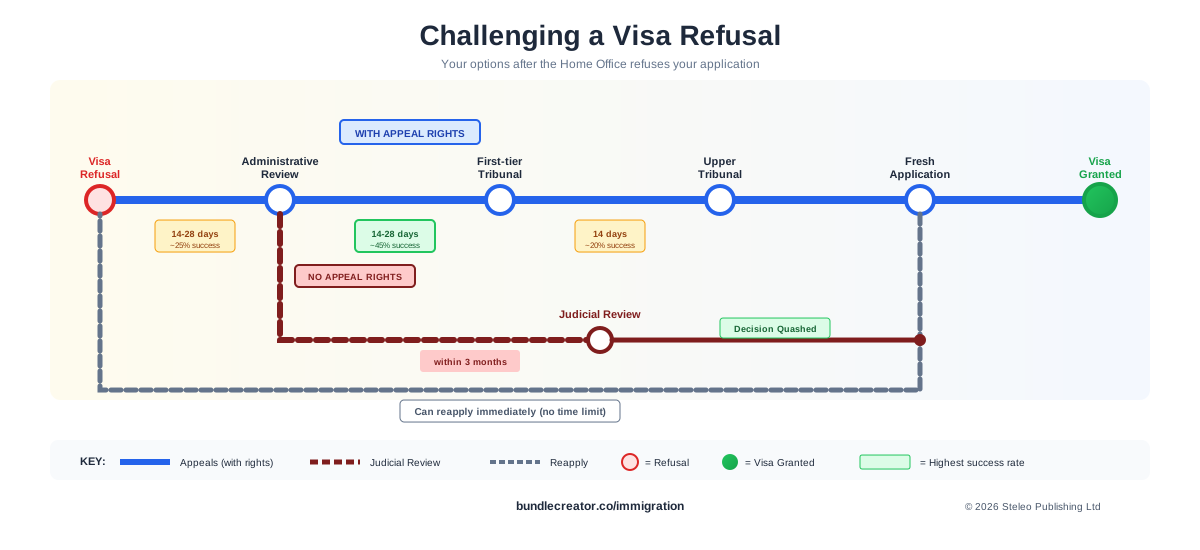
Deportation appeals for Foreign National Offenders involve different legal thresholds depending on the circumstances — consult a solicitor for advice on which threshold applies to your case. Most visa refusals carry no right of appeal; appeals lie only against refusals of protection or human rights claims, or revocation of protection status (s.82(1) NIAA 2002). Other refusals may be challenged by administrative review or judicial review.
What Goes in an Immigration Bundle?
Immigration bundles must be comprehensive yet focused. The tribunal has strict page limits in some cases, so document selection is crucial.
Home Office decision letter(s)
Appellant's witness statement
Country of origin information (COI)
Expert reports (country experts, medical)
Supporting evidence (letters, photographs)
Legal skeleton argument
Relevant case law authorities
Appeal form (online, or Form IAFT-1), and Form IAFT-5 if asking for permission to appeal to the Upper Tribunal
Manual Bundling vs Immigration Appeal Bundle Creator
See how BundleCreator streamlines your immigration tribunal bundle preparation
Feature
Manual Bundling
BundleCreator
Designed around the FtT IAC Practice Direction format
Immigration appeals — speak to a regulated adviser
Most asylum claims and many human-rights appeals warrant qualified, regulated advice. BC presents your case; the strategy stays with your legal representative.
Common questions about immigration bundles, costs, and who can use BundleCreator
BundleCreator's Immigration template produces an FtT (Immigration and Asylum Chamber) appeal bundle: the Notice of Appeal and Grounds of Appeal, the appellant's witness statement, the Reasons for Refusal letter, supporting evidence (sponsor's statements, financial documents, family-life evidence, country-of-origin information), expert reports where commissioned, and authorities. The output is paginated, indexed, bookmarked and OCR'd, with A4 pages (FtT IAC Practice Direction para 7.2) — designed to align with the IAC's Procedure Rules and electronic bundle requirements. From £19.99 a month, within your plan's bundle allowance.
Asylum appeal bundles need: the appellant's screening interview, asylum interview transcript, witness statement, the Home Office's Reasons for Refusal letter, country-of-origin information (CPIN reports, UNHCR materials, NGO reports, news articles, expert country reports), medical evidence where relevant (specialist medico-legal reports, for example from Freedom from Torture), and authorities on the Refugee Convention 1951 Article 1A(2) grounds. BundleCreator's Immigration template orders these with chronological country evidence, OCR'd for keyword search, and section bookmarks for the FtT's hearing.
Article 8 ECHR appeal bundles (private and family life) need: the appellant's witness statement and family witness statements, evidence of the relationships relied on (marriage/civil partnership certificates, children's birth certificates, photographs, communication records), evidence of integration (employment, housing, community ties, language proficiency), evidence of insurmountable obstacles to family life elsewhere where relevant, and authorities (Razgar, Beoku-Betts, Rhuppiah, Agyarko). BundleCreator's Immigration template orders these for the FtT IAC appeal.
Deportation appeal bundles for vulnerable clients (children, victims of trafficking, mental health concerns) need: the appellant's witness statement, the Home Office decision refusing the human rights claim (and the deportation decision it responds to), evidence of vulnerability (medical reports, social services involvement, NRM Conclusive Grounds decision for trafficking), best interests of any UK-settled children, and authorities (Maslov, Akpinar, ZH (Tanzania)). BundleCreator includes permanent redaction for sensitive identifiers (witness addresses, children's names, sensitive medical details) — flattened removal, not just black-highlight which leaks.
Immigration judicial review bundles need: the claim form (UTIAC1 in the Upper Tribunal, or N461 in the Administrative Court) with the Statement of Facts and Grounds; the contested decision and the evidence relied on; the Home Office's acknowledgment of service and summary grounds; its detailed grounds if permission is granted; witness statements; and authorities. Note that judicial review of an Upper Tribunal refusal of permission to appeal (the former 'Cart JR' route) was largely ousted by section 2 of the Judicial Review and Courts Act 2022, which inserted s.11A into the Tribunals, Courts and Enforcement Act 2007 — the s.11A(4) exceptions are: no valid application before the Upper Tribunal, improper constitution, bad faith, or a fundamental breach of natural justice. A claim of that kind must be brought within 16 days (CPR 54.7A). BundleCreator's Immigration template orders judicial review materials for the Upper Tribunal (Immigration and Asylum Chamber) or the Administrative Court with paginated, OCR'd, hyperlinked-index output.
Upper Tribunal (IAC) error of law hearings need: the application for permission to appeal (which stands as the notice of appeal once permission is granted), the FtT determination under appeal, the permission decision (First-tier or Upper Tribunal), any Rule 15(2A) notice of new evidence, the original FtT bundle (or relevant excerpts), skeleton arguments, and authorities. BundleCreator's Immigration template handles UT error-of-law preparation with appeal-bundle structure: pleadings, FtT determination, grounds, evidence relied on, and authorities — paginated, OCR'd, bookmarked for the UT's electronic filing.
BundleCreator's Essential tier (£19.99 a month, 15 total bundles) and Pro tier (£39.99 a month, 40 total bundles) work well for IAA level 2 and 3 advisers and small immigration practices. The tool produces FtT, Upper Tribunal, and judicial review bundles with pagination, OCR throughout, hyperlinked index, and section bookmarks. No per-seat minimums, monthly billing, no annual contract. Designed to be affordable for sole practitioners while producing tribunal-grade output.
Documents not in English must come with an English translation (rule 12(5)(b)). BundleCreator's Immigration template pairs each foreign-language exhibit with its translation in adjacent positions in the bundle, paginated together, with the translation immediately following the original. The hyperlinked index references both. Ask the Tribunal for a hearing interpreter through the online service or on Form IAFT-3.
BundleCreator runs on Google Cloud's London region (europe-west2). AES-256 at rest, TLS 1.3 in transit. Your uploaded documents, including asylum interview transcripts, vulnerable client evidence, and country-of-origin information, are stored and processed in our London (europe-west2) region, which helps avoid restricted international transfers of your documents. Account and payment details are handled by our service providers under the safeguards in our privacy policy. Designed with the solicitors' professional duty of confidentiality in mind, and particularly relevant for asylum and trafficking cases where data residency matters for client safety.
BundleCreator helps you prepare and organise documents for court and tribunal hearings. We are not a law firm and we do not give legal advice. Wherever you can, please get advice from a qualified legal adviser before your hearing. Read more
Your appeal deserves to be taken seriously.
A well-organised bundle shows the Tribunal you've prepared properly. Upload your documents — BundleCreator handles the formatting. From just £29.99.
What is the best bundle tool for a First-tier Tribunal immigration appeal?
BundleCreator's Immigration template produces an FtT (Immigration and Asylum Chamber) appeal bundle: the Notice of Appeal and Grounds of Appeal, the appellant's witness statement, the Reasons for Refusal letter, supporting evidence (sponsor's statements, financial documents, family-life evidence, country-of-origin information), expert reports where commissioned, and authorities. The output is paginated, indexed, bookmarked and OCR'd, with A4 pages (FtT IAC Practice Direction para 7.2) — designed to align with the IAC's Procedure Rules and electronic bundle requirements. From £19.99 a month, within your plan's bundle allowance.
How do I prepare an asylum appeal country evidence bundle for a Refugee Convention claim?
Asylum appeal bundles need: the appellant's screening interview, asylum interview transcript, witness statement, the Home Office's Reasons for Refusal letter, country-of-origin information (CPIN reports, UNHCR materials, NGO reports, news articles, expert country reports), medical evidence where relevant (specialist medico-legal reports, for example from Freedom from Torture), and authorities on the Refugee Convention 1951 Article 1A(2) grounds. BundleCreator's Immigration template orders these with chronological country evidence, OCR'd for keyword search, and section bookmarks for the FtT's hearing.
How do I prepare an Article 8 human rights appeal bundle?
Article 8 ECHR appeal bundles (private and family life) need: the appellant's witness statement and family witness statements, evidence of the relationships relied on (marriage/civil partnership certificates, children's birth certificates, photographs, communication records), evidence of integration (employment, housing, community ties, language proficiency), evidence of insurmountable obstacles to family life elsewhere where relevant, and authorities (Razgar, Beoku-Betts, Rhuppiah, Agyarko). BundleCreator's Immigration template orders these for the FtT IAC appeal.
How do I prepare a deportation appeal bundle for a vulnerable client requiring redaction?
Deportation appeal bundles for vulnerable clients (children, victims of trafficking, mental health concerns) need: the appellant's witness statement, the Home Office decision refusing the human rights claim (and the deportation decision it responds to), evidence of vulnerability (medical reports, social services involvement, NRM Conclusive Grounds decision for trafficking), best interests of any UK-settled children, and authorities (Maslov, Akpinar, ZH (Tanzania)). BundleCreator includes permanent redaction for sensitive identifiers (witness addresses, children's names, sensitive medical details) — flattened removal, not just black-highlight which leaks.
How do I prepare a judicial review immigration bundle?
Immigration judicial review bundles need: the claim form (UTIAC1 in the Upper Tribunal, or N461 in the Administrative Court) with the Statement of Facts and Grounds; the contested decision and the evidence relied on; the Home Office's acknowledgment of service and summary grounds; its detailed grounds if permission is granted; witness statements; and authorities. Note that judicial review of an Upper Tribunal refusal of permission to appeal (the former 'Cart JR' route) was largely ousted by section 2 of the Judicial Review and Courts Act 2022, which inserted s.11A into the Tribunals, Courts and Enforcement Act 2007 — the s.11A(4) exceptions are: no valid application before the Upper Tribunal, improper constitution, bad faith, or a fundamental breach of natural justice. A claim of that kind must be brought within 16 days (CPR 54.7A). BundleCreator's Immigration template orders judicial review materials for the Upper Tribunal (Immigration and Asylum Chamber) or the Administrative Court with paginated, OCR'd, hyperlinked-index output.
How do I prepare an Upper Tribunal error of law immigration bundle?
Upper Tribunal (IAC) error of law hearings need: the application for permission to appeal (which stands as the notice of appeal once permission is granted), the FtT determination under appeal, the permission decision (First-tier or Upper Tribunal), any Rule 15(2A) notice of new evidence, the original FtT bundle (or relevant excerpts), skeleton arguments, and authorities. BundleCreator's Immigration template handles UT error-of-law preparation with appeal-bundle structure: pleadings, FtT determination, grounds, evidence relied on, and authorities — paginated, OCR'd, bookmarked for the UT's electronic filing.
Is there a bundling tool for an IAA-regulated adviser at sole-practice scale?
BundleCreator's Essential tier (£19.99 a month, 15 total bundles) and Pro tier (£39.99 a month, 40 total bundles) work well for IAA level 2 and 3 advisers and small immigration practices. The tool produces FtT, Upper Tribunal, and judicial review bundles with pagination, OCR throughout, hyperlinked index, and section bookmarks. No per-seat minimums, monthly billing, no annual contract. Designed to be affordable for sole practitioners while producing tribunal-grade output.
How do I bundle interpreter coordination and foreign-language exhibits?
Documents not in English must come with an English translation (rule 12(5)(b)). BundleCreator's Immigration template pairs each foreign-language exhibit with its translation in adjacent positions in the bundle, paginated together, with the translation immediately following the original. The hyperlinked index references both. Ask the Tribunal for a hearing interpreter through the online service or on Form IAFT-3.
Is there a UK-hosted bundling tool for asylum and immigration — confidential client information?
BundleCreator runs on Google Cloud's London region (europe-west2). AES-256 at rest, TLS 1.3 in transit. Your uploaded documents, including asylum interview transcripts, vulnerable client evidence, and country-of-origin information, are stored and processed in our London (europe-west2) region, which helps avoid restricted international transfers of your documents. Account and payment details are handled by our service providers under the safeguards in our privacy policy. Designed with the solicitors' professional duty of confidentiality in mind, and particularly relevant for asylum and trafficking cases where data residency matters for client safety.